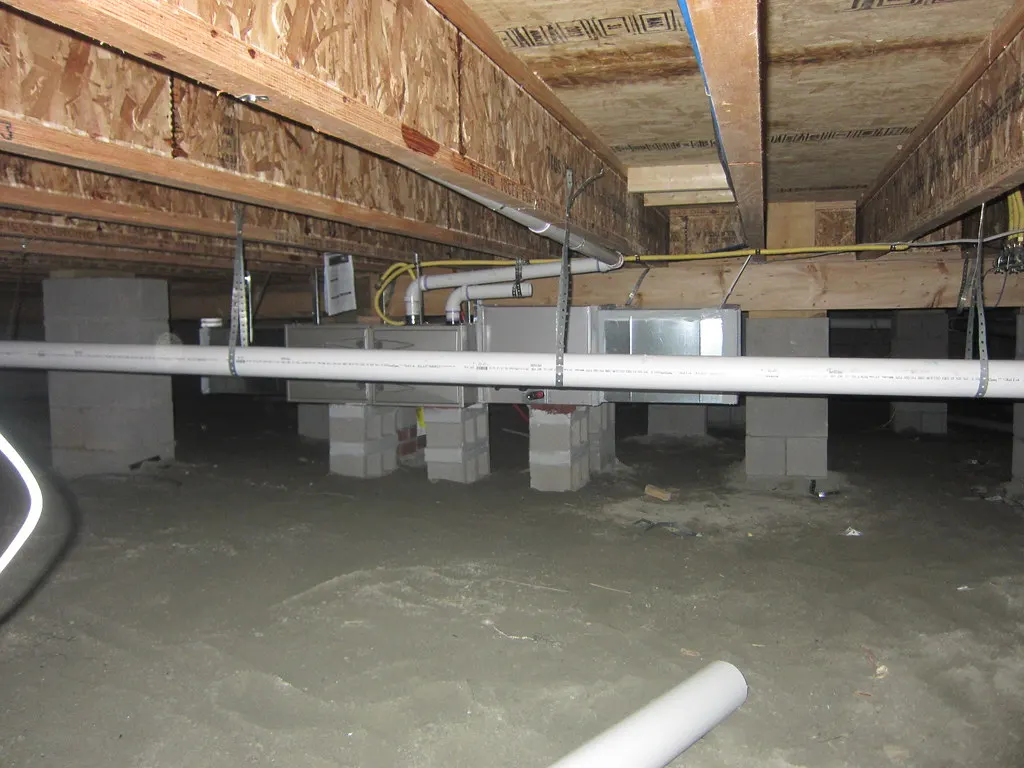
A crack in a foundation wall is easy to stare at and hard to read. Some cracks are old and done moving. Others are the first sign that a wall or pier is shifting. If your Mooresville home sits on a crawl space, the foundation is mostly hidden: a ring of block or brick around the outside, and a row of piers holding up the middle of the house.
What foundation trouble looks like on a crawl space home
Crawl space foundations don't fail the way a basement or slab does. Here's what homeowners around Lake Norman usually spot first:
- Stair-step cracks running up the mortar joints of a block or brick wall, often near a corner
- A horizontal crack partway up a block wall, sometimes with the wall pushed inward
- A wall that bows or leans, which you can sometimes see by sighting down it from one end
- Piers that tilt, crack or sink, leaving a gap between the pier and the beam above
- Doors and windows that start to stick in one part of the house, or new cracks in drywall over a doorway
One crack doesn't mean trouble. Several together, or a crack that widens over a season, is worth a look.
Why foundations move here
Most foundation movement comes back to soil and water.
Red clay. The clay around Mooresville swells when it's wet and shrinks when it dries out. That cycle, repeated year after year, pushes and pulls on footings and walls. After a long dry spell followed by heavy rain, it's common to see a crack open up that wasn't there before.
Water against the wall. Gutters that overflow, downspouts that empty at the foundation and soil that slopes toward the house keep the clay next to the wall soaked. Wet clay is heavier and pushes harder. That pressure is what bows block walls inward.
Sloped lots. Many lake homes are built into a hill. The uphill wall holds back the most soil, and it usually cracks or leans first.
Piers on poor footings. Interior piers carry a lot of weight. If one was set on a small footing, or on soil that later got wet, it can settle and take the floor with it.
Age. Older block foundations in town can have mortar that has softened over decades.
How foundation repair works on a crawl space
The fix depends on what's moving and how far it's gone. A good contractor explains what they found first.
Stabilizing bowing or leaning walls
When a block wall is pushing in, the goal is to stop it from going further. Common methods include wall anchors (plates on the inside tied to anchors set in the soil outside), steel braces that run from the footing to the floor framing, and carbon fiber straps bonded to the wall. Some walls can be pulled back slowly over time with anchors. Walls that have moved too far may need a section rebuilt.
Fixing settling piers
A sinking pier can be rebuilt on a proper footing, or new supports can take the load. When the problem is the soil under the footings, some contractors use steel piers driven or screwed down to firmer ground. That's a bigger job, and the contractor should explain why it's needed instead of a simpler repair.
Repairing cracks and mortar
Stable cracks can often be sealed or repointed (old mortar raked out and replaced). Sealing a crack that's still moving just hides it, so a good contractor checks that first.
Handling the water
Almost every foundation repair should come with a plan for water. Gutters, downspout extensions and grading outside, and crawl space waterproofing or drainage inside, take pressure off the walls so the repair lasts.
Foundation or floor framing? Know which one you have
A sagging floor isn't always a foundation problem. Often it's the joists, beams or the spacing of supports under the house, and that's handled with floor joist repair. A foundation problem shows up in the masonry: cracked or bowing walls, tilting or sinking piers. Sometimes both are going on at once. The free crawl space inspection sorts that out, with photos of the walls, piers and framing so you can see the difference yourself.
What drives the price
Foundation work ranges widely. Repointing a few cracks is a small job. Anchoring a long bowing wall, rebuilding several piers or installing steel piers is a much larger one. The main factors are:
- How many walls or piers are involved, and how far they've moved
- The repair method (anchors, braces, straps, rebuilt piers or steel piers)
- Crawl space height and access, since the work is done on hands and knees or lying down
- Digging outside, which means the contractor calls NC811 first to mark utilities
- Whether an engineer's evaluation or a permit is needed
Larger structural repairs often need a permit, and some call for a structural engineer to sign off. When that's the case, the contractor pulls the permit and should tell you up front. See the crawl space cost guide for how pricing works in general.
What to ask any foundation contractor
- What's moving, and how do you know it's still moving?
- Why this repair method instead of a simpler one?
- What happens to the water that caused it?
- Will this need a permit or an engineer?
This site covers Mooresville and nearby towns like Troutman, Davidson, Cornelius and Denver. If you're not sure your address is covered, just call.
Questions people ask
Are stair-step cracks in a block foundation serious?
They can be minor or they can mean a corner is settling. Thin cracks that haven't changed in years are often old movement. Cracks that are getting wider, or that come with sticking doors and sloping floors, should be looked at soon.
Can a bowing crawl space wall be straightened?
Sometimes. Walls that haven't moved far can often be stabilized, and some can be pulled back gradually with wall anchors over time. Walls that have moved a lot may need a section rebuilt. The contractor should tell you which is realistic before work starts.
Do I need a structural engineer for foundation repair?
Not for every job. Repointing or sealing stable cracks usually doesn't need one. For bowing walls, steel piers or bigger structural work, an engineer's evaluation is common and may be required for a permit. Ask the contractor whether your repair falls into that group.
Will fixing my foundation stop new cracks in the house?
Stabilizing the foundation stops the movement causing the cracks, but drywall and brick cracks that already exist usually need their own repair. Handling the water around the foundation is a big part of keeping new cracks from forming.